Estrella Hits High Grade Manganese as Timor-Leste Play Gathers Pace

Estrella Resources (ASX: ESR) has confirmed high-grade manganese assays from its Ira Miri prospect in Timor-Leste, with today's ASX update marking a major milestone in the junior’s push to define a maiden resource in the fledgling Southeast Asian nation.
The headline results—6.45m at 51.7% Mn from EMDD001 and 8.05m at 53.0% Mn from EMDD002—are some of the highest grade manganese intercepts seen on the ASX this year, especially impressive given they come from surface or near-surface depths. These were complemented by 1.5m at 35.8% Mn in EMDD003, suggesting consistent mineralisation within the targeted Noni Formation.
Estrella's managing director Chris Daws was characteristically upbeat: “These first assays… confirm our initial discoveries and demonstrate the potential for Timor-Leste to host high-grade manganese mineralisation.” He also noted the broader significance of the program: “Estrella continues to successfully prove up its manganese targets as we progress the early stages of Timor-Leste’s first ever modern minerals drilling.”
The company is wasting no time. Having drilled over 20 holes to date, including scout drilling to map stratigraphy and now targeting angled holes to follow primary mineralisation, Estrella’s program is not just exploratory—it’s evolving towards production-level definition. The next goal? A market appraisal parcel of 20,000–30,000 tonnes of supergene manganese to be extracted by year’s end.
Today’s release builds on a flurry of exploration activity reported over recent weeks:
On 15 September, Estrella announced further intersections west of the discovery zone, with holes EMDD025 and EMDD026 returning visual estimates of 2.5m at 70% and 3.1m at 60% manganese oxides respectively.
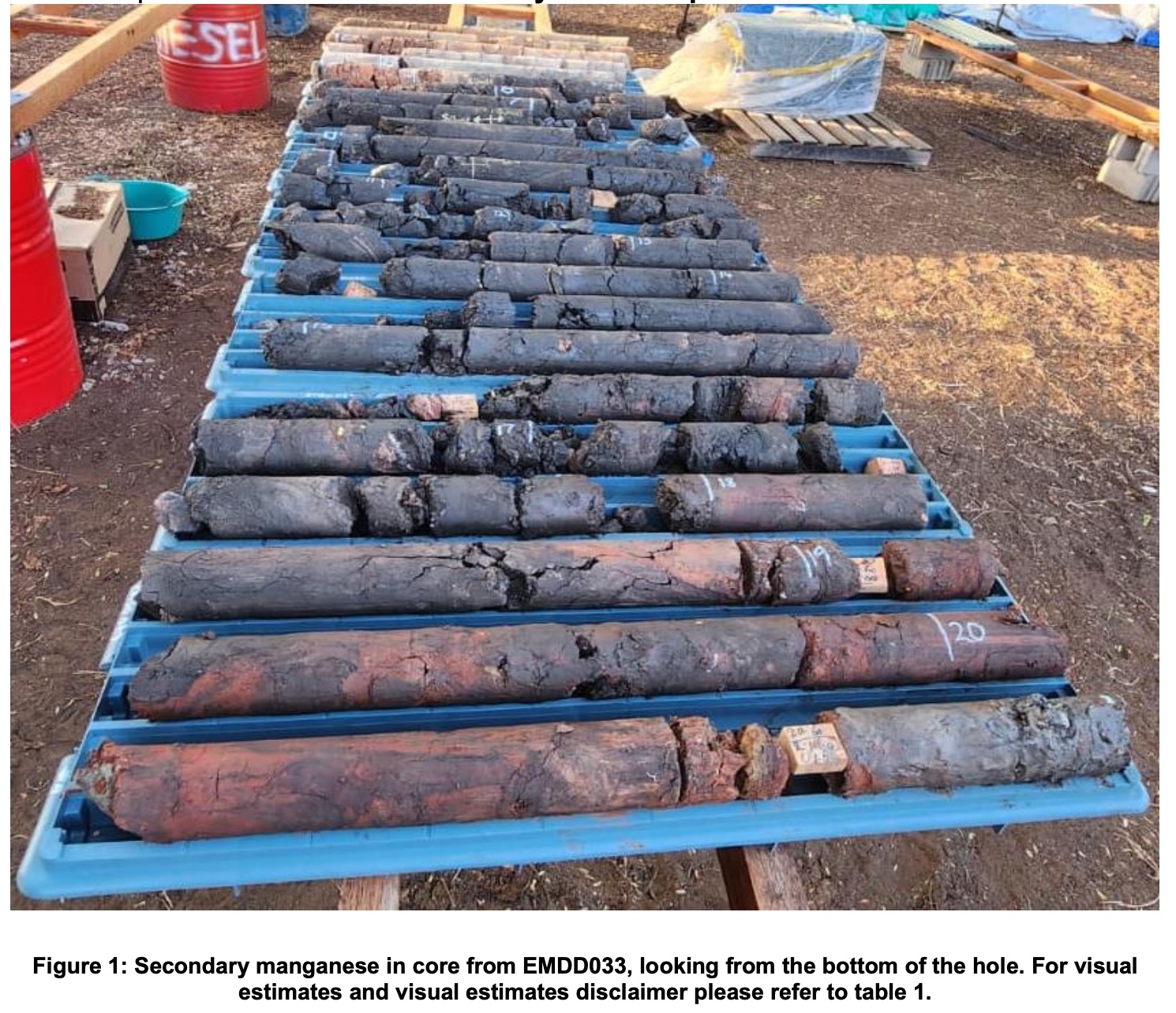
Then on 22 September, the company reported broad supergene zones to the northwest, with EMDD033 intersecting a whopping 12.87m of 80% manganese oxides from just 5.13m depth, and EMDD032 returning 11.65m of manganese-rich material, including 8.3m at 60%.
These visual results have assay confirmation pending, expected within six to eight weeks, and if consistent with earlier samples, Estrella could be sitting on a high-grade supergene manganese resource right at surface—ideal for low-cost extraction.
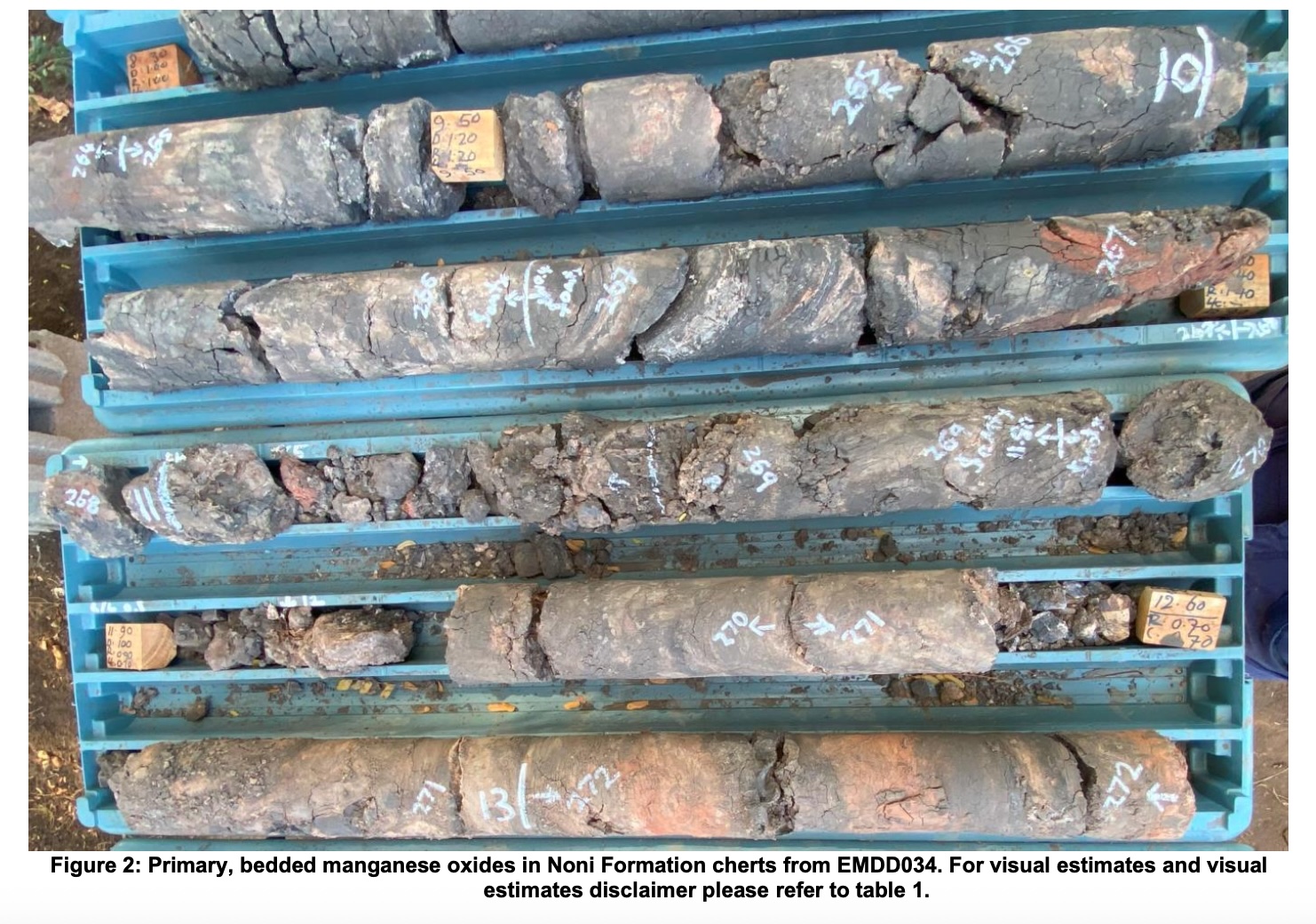
The geology tells a compelling story. The mineralisation is hosted within the Noni Formation, a chert-rich sequence now revealed to contain primary manganese horizons that have been redistributed into flatter, enriched supergene zones by weathering processes. Estrella’s current focus is to chase these mineralised beds along strike and down-dip, using both trenching and angled drilling to model the continuity and geometry of these lenses.
Importantly, the company is also deploying modern survey tools to get ahead of the drill bit. A LiDAR and Drone-Mag campaign kicked off in late August, followed by MobileMTd surveys to detect subsurface conductors—potentially mapping further high-grade manganese targets before they’re drilled.
While manganese has often played second fiddle to lithium and copper in the battery minerals narrative, its critical role in steel production and emerging battery chemistries (notably LFP and NMC cathodes) keeps demand forecasts robust. The fact that Estrella’s manganese is high grade, near surface, and just 25km from port infrastructure in Timor-Leste only sweetens the deal.
For a company that only began drilling in this region months ago, the pace and scale of progress is striking. Estrella’s Timor-Leste campaign is shaping up to be one of the more exciting frontier mineral plays on the ASX, and today’s assay results provide the strongest evidence yet that it’s not just smoke—it’s manganese fire.
As Daws succinctly put it: “Go Estrella!”
