Terrain Minerals (ASX:TMX) charts a multi-pronged path to discovery in gold, lithium, gallium and rare earths

Terrain Minerals (ASX:TMX) has emerged from the December quarter with the enviable problem of too many irons in the fire - and for once, that’s not a euphemism for under-delivery. The junior explorer, long active in Western Australia’s gold country, is now pacing ahead on multiple fronts, with drill rigs spinning, geophysics pointing to hidden potential, and cash in the bank to keep things moving.

The company’s December 2025 quarterly report reads less like a dry regulatory update and more like a prospectus for 2026, as Terrain advances towards key milestones across its gold-silver and critical minerals portfolio.
Smokebush: From hopeful to resource-ready
At the heart of the update is the Smokebush Project, located in WA’s Murchison region — a belt already crowded with successful gold operations like Mt Gibson and Rothsay. Terrain’s flagship target here is the Lightning prospect, a geophysics-guided gold-silver discovery that continues to deliver thick, high-grade intercepts.
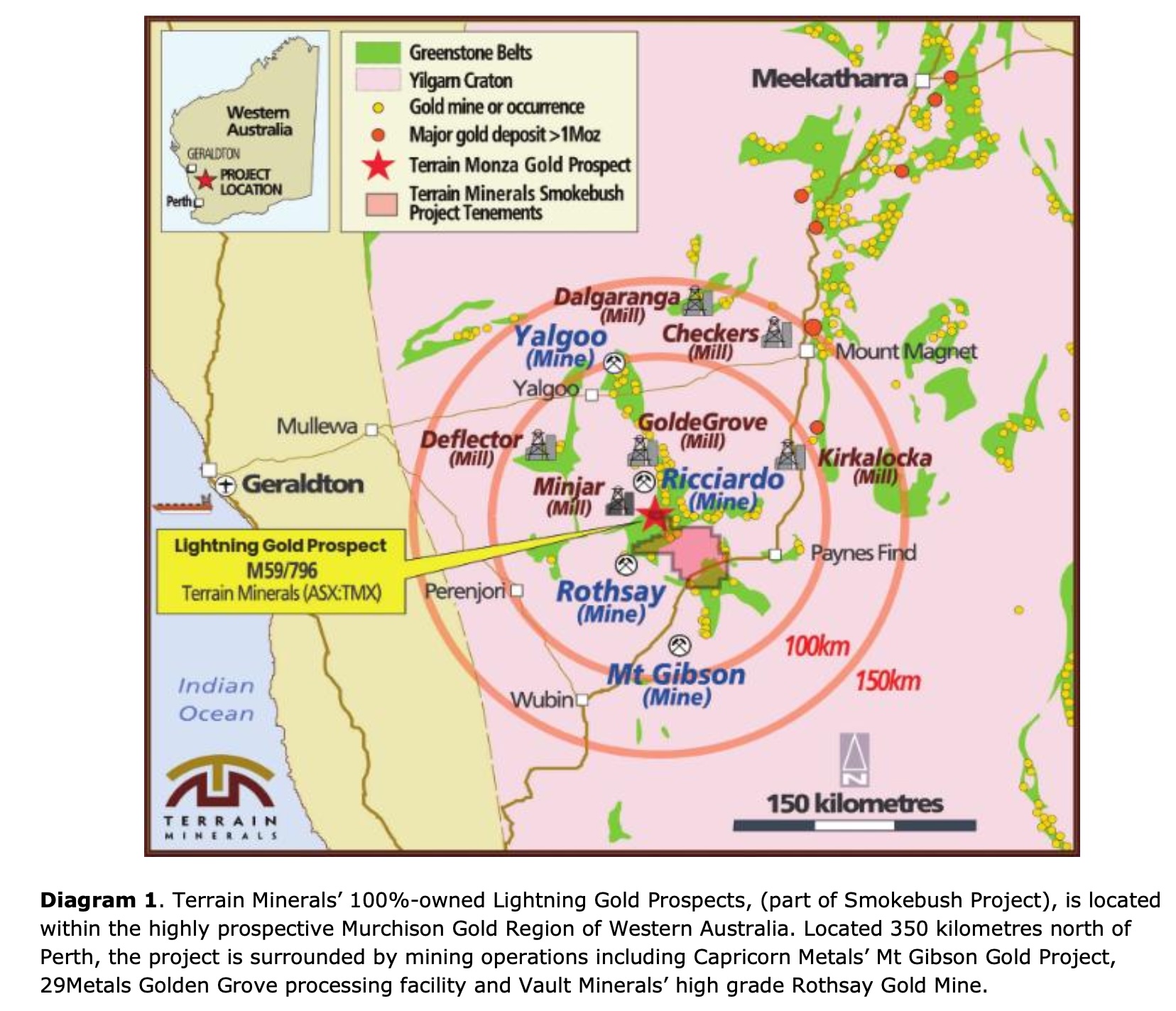
In November, the company kicked off a 34-hole, 6,800 metre reverse circulation (RC) program across the project, with 21 holes dedicated to Lightning. Before the Christmas hiatus, 12 holes were completed - assays are pending and expected in early 2026. Drilling is scheduled to resume shortly.
The results will feed into what Terrain hopes will be its first mineral resource estimate at Lightning, now targeted for mid-2026. That ambition took a tangible step forward during the quarter, with the granting of a mining lease over the Lightning area - an administrative win that clears the way for feasibility work down the line.
If the pending assays match prior results - such as 11 metres at 6.03 g/t gold and 43.5 g/t silver from 75 metres (SBRC063) - the path to a maiden JORC resource may be a straight one.
Wildflower blooms next
South of Lightning, the Wildflower prospect is about to get its moment. IP geophysics completed in late 2025 outlined three chargeability anomalies beneath gold-in-soil trends - a textbook setup for a near-mine discovery.
The Wildflower drill program, already designed and approved, comprises 13 RC holes for 2,300 metres and is expected to commence as soon as the Lightning rig completes its current job. Terrain is targeting results by April.
Notably, the geophysical model that identified Lightning’s mineralisation is now being used at Wildflower and other satellite targets like Paradise City and Hurley. If history repeats, Terrain could be on the cusp of a cluster of discoveries within the same structural corridor.
Lithium in the Pilbara: Carlindie kicks off
Over in the Pilbara, Terrain’s Carlindie Lithium Project is in its early innings but sits in the right postcode. The company completed an ultra-low-cost soil sampling program in the December quarter - 822 samples over a 15km strike - along the same structural trend as Wildcat Resources’ Tabba Tabba lithium discovery.
Samples are with the lab, and Terrain expects results to define potential drill targets. The exploration model, reinforced by Wildcat’s recent discoveries in felsic rocks, challenges the orthodox view that lithium pegmatites are confined to greenstone belts. If correct, Terrain could be onto a fertile stretch of under-explored terrain.
Lort River: REE potential deepens
Meanwhile, the Lort River rare earths project near Esperance has quietly become one of the company’s most intriguing assets. An airborne electromagnetic (AEM) survey during the quarter mapped a 66-square-kilometre regolith basin - shallow, lateritic and, based on prior drilling, enriched in rare earths.
The correlation between conductive zones and known mineralisation is encouraging. Terrain plans to follow up with air-core drilling and metallurgical test work in the first quarter, keeping the REE momentum going.
The project already boasts intersections like 8 metres at 4,037 ppm total rare earth oxides (TREO), including 1 metre at nearly 1% TREO. Importantly, these are clay-hosted, near-surface targets - potentially lending themselves to low-cost extraction, a major drawcard in the current REE market.
Gallium gets strategic
Also within the Smokebush footprint lies the Larin’s Lane gallium-REE prospect, where metallurgical test work is now underway as part of a broader WA government-backed research initiative (MRIWA Project M10528). With gallium increasingly viewed as a strategic material in semiconductors, AI chips and defence, the market is watching early-stage projects like Larin’s Lane more closely.
Terrain expects metallurgical results by March, with further drilling and a possible Phase Two exploration target to follow.
Capital secured, momentum preserved
Terrain’s ability to maintain this broad front of activity rests largely on its funding position - and on that front, the company moved decisively.
The December quarter saw Terrain complete two placements totalling $2.76 million, with cornerstone support from executive director Justin Virgin, who committed $450,000 (subject to shareholder approval). The second placement - in December - was completed at no discount to the prevailing market price, a feat in itself in late 2025.
The company is now fully funded for the current drill campaigns at Lightning and Wildflower, as well as for planned diamond drilling required to underpin the JORC resource estimate.
What’s next?
2026 is shaping up as a defining year for Terrain. With:
Drill results from Lightning due imminently,
Wildflower drilling starting soon,
Metallurgical results from Larin’s Lane pending, and
A maiden resource estimate on the cards,
investors will have no shortage of catalysts to watch.
Terrain may be a minnow, but it’s one with its head down and drills turning. If the geology continues to cooperate, it could soon be punching above its market cap.